

Weekly check of the market
Magnificent 7, Nasdaq and S&P500
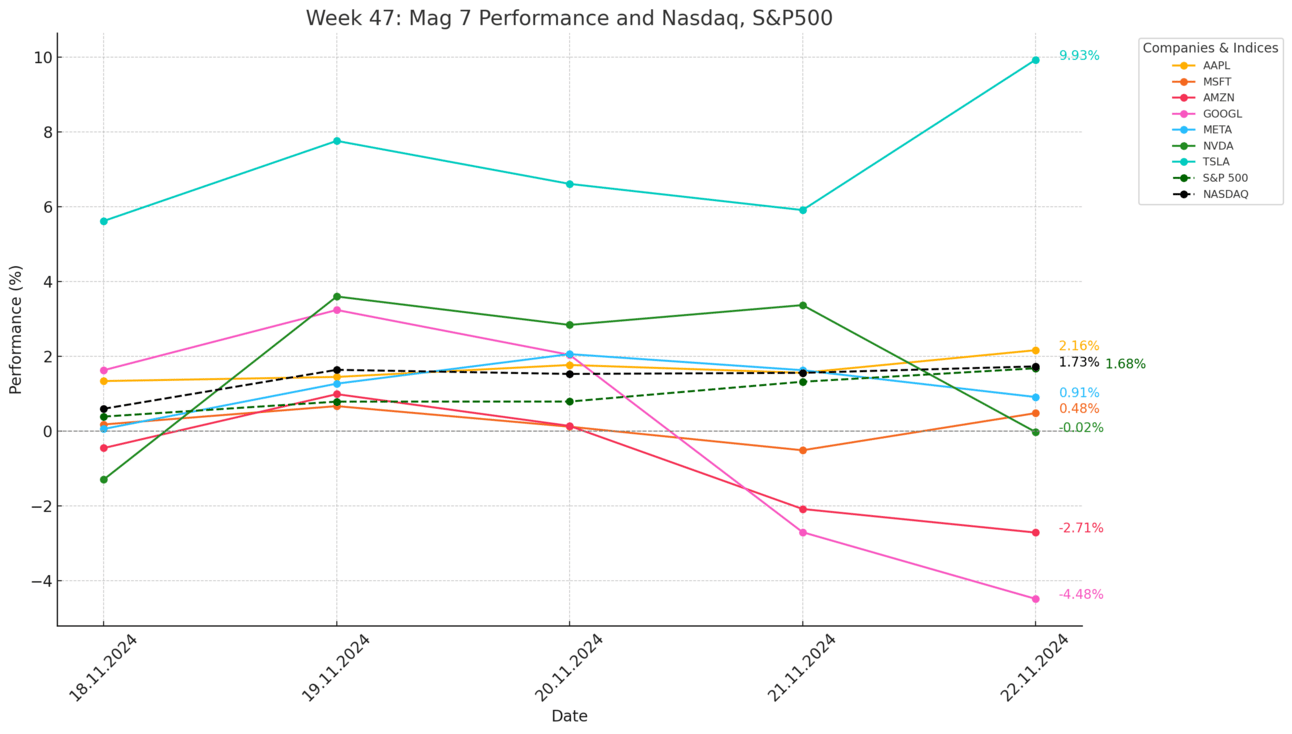
Tesla was the big winner this week, soaring almost 10%. Investors got excited about new regulations that could speed up its self-driving tech, combined with Elon Musk’s government role, which gave people hope for smoother sailing in the future. Apple also had a good week, gaining over 2%
On the other hand, Google faced significant challenges this week, with its stock dropping over 4% due to mounting regulatory and competitive pressures. The U.S. Department of Justice proposed that Google sell its Chrome browser to address antitrust concerns, threatening its dominance in advertising and search. Simultaneously, AI competitors like Perplexity AI and OpenAI gained traction with innovative search tools, including OpenAI's discussions with Samsung to power AI features, which could undermine Google's key Android partnership. These developments, combined with increasing advertising competition and regulatory risks, shook investor confidence and dragged down Alphabet’s stock.
Amazon didn’t do much better, down nearly 3% this week, as growing competition from companies like Walmart, Temu, and Shein put pressure on the company. Walmart’s raised guidance for Q4, signaling strong expectations for the holiday season after a better-than-expected earnings report. Additionally, despite Amazon announcing a further $4 billion investment in AI startup Anthropic, the news failed to reverse the downward trend. The investment strengthens Amazon’s position in the AI space, making Anthropic's models reliant on AWS and Amazon's AI chips. While the partnership boosts Amazon’s AI ambitions, it didn’t alleviate concerns about its core retail and e-commerce business, especially with increasing competition and macroeconomic uncertainties.
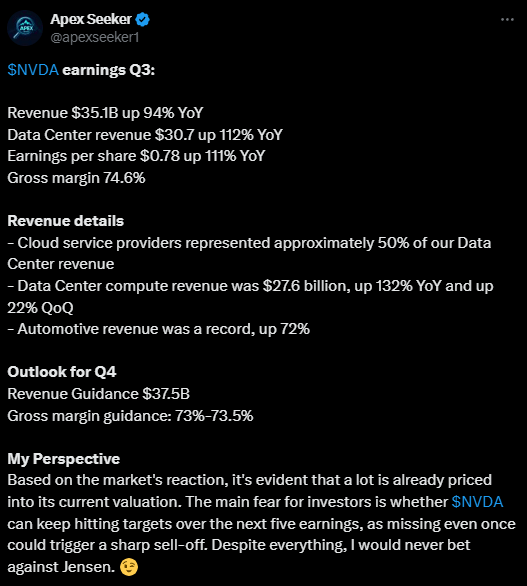
Nvidia was flat for the week, which was a surprise since they reported their earnings showing spectacular growth. Sales surged by 94% in the fiscal third quarter to $35.1 billion, with profits more than doubling to $19.3 billion, both figures exceeding Wall Street forecasts. The company also projected revenue of $37.5 billion for the current quarter, surpassing expectations, fueled by strong demand for its next-generation AI chips(Blackwell). These chips, which are set to ship this quarter, are already in high demand from major customers like Microsoft, Google, Meta, and Elon Musk’s xAI. Nvidia expects Blackwell to remain in short supply well into its next fiscal year, highlighting its dominant position in the AI chip market.
Meta inched up about 1% this week despite news of a proposed Australian law prohibiting children under 16 from accessing social media platforms like Instagram. The legislation, if enacted, would require platforms to implement strict age-verification measures, with non-compliance leading to fines of up to A$50 million. While this bill raises concerns about potential user base reductions and compliance costs for companies like Meta, investors appeared focused on the company's ongoing advancements in AI and continued efforts to streamline operations, which have been bolstering profitability.
Microsoft made a small gain of 0.5%
Overall, the S&P 500 and Nasdaq had a decent week, both up around 1.7%. The broader market stayed steady despite some ups and downs among the big tech names.
Bitcoin came within 1% of reaching $100K on November 22, 2024, but has since cooled down. It is currently trading at $96,346, still up 5.80% for the week.
Fear & Greed Index
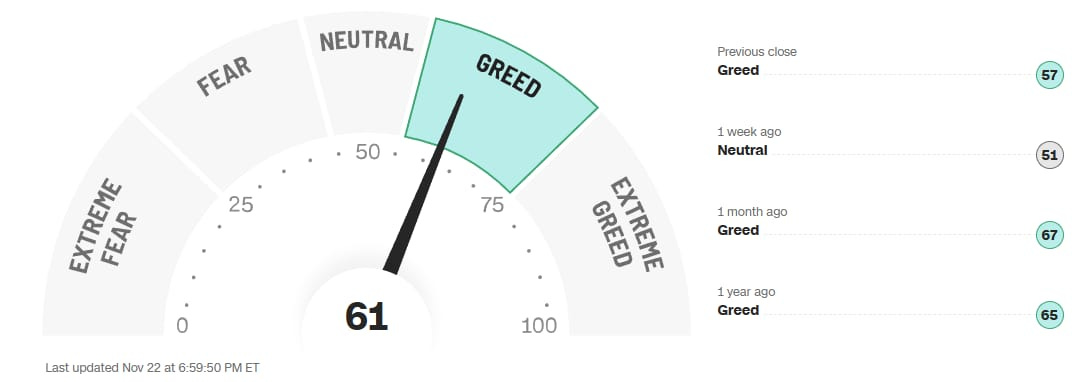
Source: CNN Business
With closely approaching extreme greed, I always recommend being cautious and smart about your moves in the market.
CBOE Volatility Index (VIX)
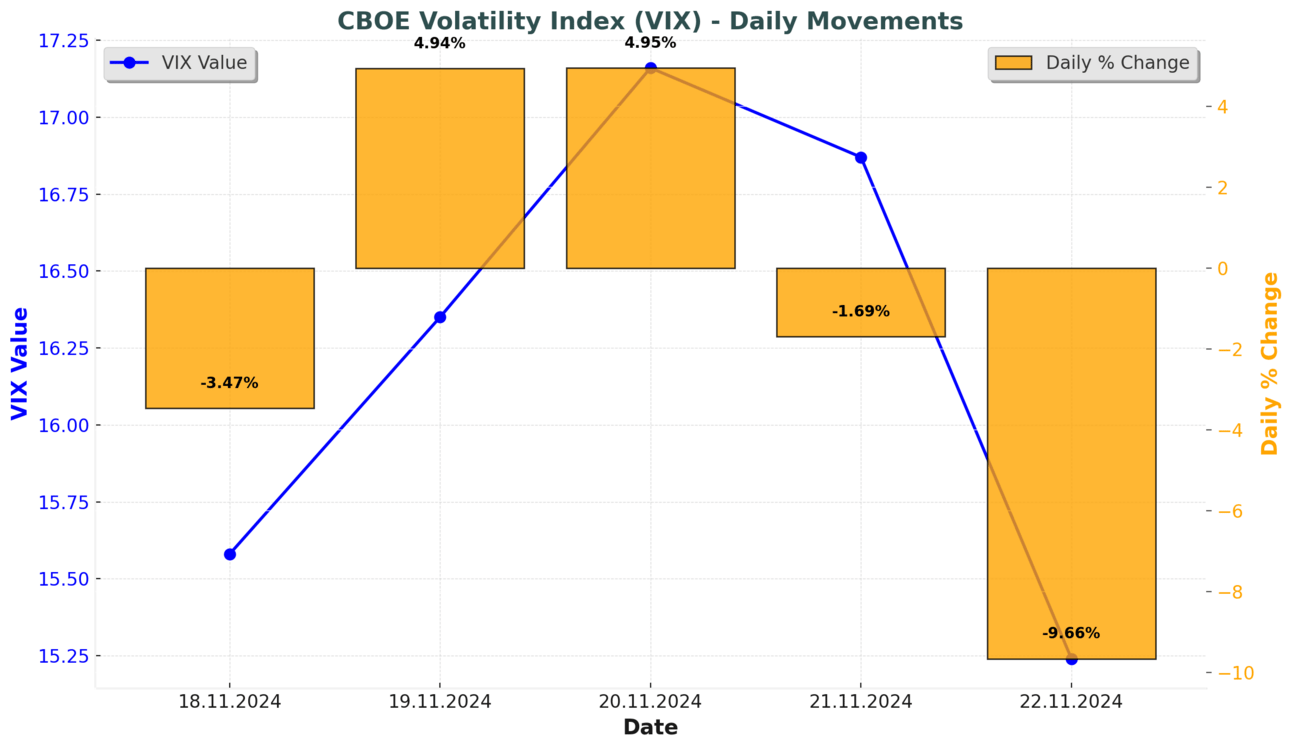
I believe the above data clearly shows how much the market depends on the Nvidia numbers. Thank you, “Jensen,” for keeping us on the upward trend.
Outliers
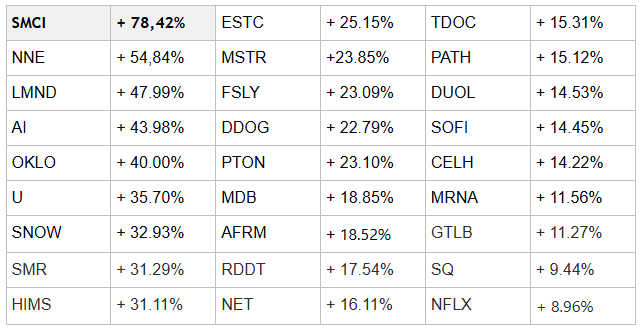
Make sure to understand I could absolutely put hundreds of outliers more, but these are the ones I am also following, so they are under my radar. They reflect a broader theme of investor optimism, particularly in clean energy, AI, and high-growth technology sectors. Both nuclear and tech growth stories are captivating markets with potential for continued outperformance.
Earnings of the week
Nvidia
Snowflake
Snowflake’s stock soared over 30% Thursday, marking its largest percentage gain ever, after posting better-than-expected Q3 results and announcing a major generative AI partnership. Revenue reached $942.1 million, up 28% year-over-year, with product revenue at $900.3 million, surpassing forecasts. The company also provided a strong Q4 outlook, easing competition concerns and reinforcing confidence in cloud infrastructure demand. Snowflake’s new partnership with Anthropic will integrate Claude AI models into its platform, enabling businesses to build AI applications securely and efficiently. While these AI initiatives won’t boost near-term revenue, analysts expect them to drive growth by fiscal 2026.
Walmart
Walmart’s latest earnings show strong U.S. sales growth, with comparable sales rising 5.3%, surpassing analyst expectations of 3.9%. Holiday shopping is off to a solid start, driven by demand for toys, groceries, and home goods. The retailer raised its annual sales and profit outlook, forecasting comparable sales growth of up to 5.1%. E-commerce sales grew 27% year-over-year, now making up 18% of global revenue. Walmart reported higher profits thanks to fewer discounts, reduced delivery costs, and strong advertising revenue. While non-food spending remains slower, Walmart continues to attract high-income shoppers with premium products. Executives remain optimistic despite potential new tariffs under the incoming Trump administration, which the company is monitoring closely.
Target
Target shares plummeted 21% after the company missed quarterly earnings expectations and slashed its annual profit and sales outlook. Despite price cuts boosting foot traffic, consumers spent less on nonessential items like apparel and home goods, leading to flat sales growth of 0.3%, below the 1.5% analysts expected. Profits also fell, partly due to higher import costs from early inventory ahead of a brief port strike. In contrast, competitors like Walmart and Costco reported stronger results, benefiting from higher grocery sales and demand for discretionary goods. Target now expects annual earnings of $8.30 to $8.90 per share, down from its earlier forecast, as it navigates cautious consumer spending and potential tariffs under the incoming Trump administration.
NIO
NIO Inc. reported its Q3 2024 financial results, showcasing record vehicle deliveries of 61,855 units, up 11.6% YoY, with revenues of RMB 18.67 billion (US$2.66 billion), a 7% QoQ increase. Despite growth in deliveries and gross margins (10.7%, up from 9.7% QoQ), the company posted a net loss of RMB 5.06 billion (US$721 million). Challenges included a lower average selling price and rising operational costs. Overall, experts believe NIO’s robust vehicle delivery growth and strategic investments are encouraging, but profitability challenges and competitive pressures in the EV market remain key hurdles.
Baidu
Baidu's Q3 2024 earnings report showcased resilience amidst challenges, beating market expectations despite a 3% annual revenue decline, reaching $4.78 billion. Net income surged 14% to $1.09 billion, driven by robust growth in its AI cloud segment, which saw non-online marketing revenue climb 12%. The company's flagship Ernie AI model and chatbot demonstrated strong adoption, with usage more than doubling since August, signaling broader recognition of Baidu's AI capabilities. Generative AI accounted for 11% of AI cloud revenue, up from 9% last quarter. Baidu's AI-focused strategy also underpinned growth in autonomous ride-hailing via Apollo Go, with rides increasing 20% year-over-year. However, weak online ad spending from small businesses and China's slower economic stimulus effects weighed on the traditional revenue streams.
News of the week
Amazon Invests an Additional $4 Billion in AI Firm Anthropic
Amazon has invested an additional $4 billion in Anthropic, an AI firm behind the Claude chatbot, deepening ties with one of OpenAI's main rivals. The deal strengthens Anthropic's use of AWS services and AI chips, boosting Amazon's presence in the AI market.
OpenAI Considers Taking on Google With Browser
OpenAI is gearing up to challenge Google by exploring a web browser combined with its ChatGPT AI, aiming to revolutionize how users interact with the web. Dubbed NLWeb (Natural Language Web), the project seeks to integrate conversational AI into websites, enabling users to ask natural-language questions for personalized results, such as finding coats for specific trips or pairing recipes with dishes. OpenAI has also struck deals with developers like Condé Nast and Redfin, positioning its tools as a transformative alternative to traditional search. With ChatGPT boasting 300 million weekly active users, OpenAI has become a significant player in AI search, rivaling Google’s dominance. It has hired former Chrome developers and is pursuing partnerships with device makers like Samsung. This aggressive move mirrors Google’s early strategy of building Chrome to protect its ecosystem.
Google Should Be Forced to Sell Chrome Browser, Justice Department Says
The U.S. Department of Justice has proposed that Google sell its Chrome browser to address its monopolization of the search market. This drastic move, following an antitrust victory, aims to restore competition by separating Google’s search engine from its other products, like Chrome and Android.
Perplexity’s AI search engine can now buy products for you
Perplexity has introduced a new feature allowing Pro subscribers to purchase products directly through its AI search engine using a "Buy with Pro" button. This tool simplifies shopping by offering free shipping and leveraging saved payment details. Perplexity also launched features like AI-generated product cards and "Snap to Shop," enhancing its shopping experience and competing with tools like Google Lens. This move highlights Perplexity’s push to innovate in AI-driven e-commerce.
TikTok CEO Seeks Musk’s Counsel on Incoming Trump Administration
TikTok CEO Shou Chew has reportedly reached out to Elon Musk for insights on navigating the incoming Trump administration. With Musk’s close ties to President-elect Trump and influence in shaping tech policy, ByteDance sees him as a valuable connection. TikTok faces a potential U.S. ban by mid-January unless ByteDance divests the platform, a demand the company is fighting through a federal lawsuit. Musk’s proximity to Trump and his role in policy discussions has led to cautious optimism for a potential resolution for TikTok’s U.S. operations.
Super Micro Computer Submits Nasdaq Compliance Plan
Super Micro Computer (SMCI) has submitted a plan to the Nasdaq to regain compliance after missing deadlines for financial reports. The company hired BDO USA as its independent auditor to address accounting issues following Ernst & Young's resignation. Despite earlier guidance cuts and governance concerns, SMCI’s stock surged, gaining 26% in after-hours trading as investors showed confidence in its recovery efforts.
Amazon Web Services Launches Quantum-Computing Advisory Program
Amazon Web Services (AWS) has launched Quantum Embark, an advisory program designed to help organizations explore quantum computing applications tailored to their business needs. Building on AWS's Braket platform, the program offers modules like Use Case Discovery, Technical Enablement, and Deep Dive to guide users in identifying and leveraging quantum solutions. Shares of quantum-computing firms surged following the announcement, with Quantum Computing Inc. up 28%, D-Wave Quantum up 48%, and Arqit Quantum rising 26%. The move underscores AWS's commitment to leading innovation in quantum technology.
Tesla gains on report Trump's team planning federal self-driving vehicle regulations
Tesla shares climbed following reports that President-elect Donald Trump's team plans to implement federal regulations for autonomous vehicles. Elon Musk’s role in Trump’s administration has sparked optimism about streamlining approval for Tesla's Full Self-Driving (FSD) technology. While regulatory hurdles and safety investigations remain, investors view Musk’s ties to the White House as a potential advantage, boosting Tesla’s market value past $1 trillion. This development underscores growing confidence in Tesla’s leadership in autonomous driving innovation.
Australia wants to ban kids from social media. Will it work?
Australia is proposing a groundbreaking ban on social media for children under 16, aimed at protecting kids from online harm. While many parents welcome it as a step to let children experience life offline, experts warn it’s a blunt instrument with potential drawbacks, such as pushing kids toward unsafe online spaces. Questions remain about how the ban will be enforced, with challenges in age verification and maintaining user privacy.
Trump Picks Scott Bessent as Treasury Secretary
Donald Trump has nominated hedge-fund manager Scott Bessent as Treasury Secretary. A key economic adviser, Bessent supports Trump’s "America First" agenda, advocating growth through deregulation and energy production while addressing trade policies like tariffs. If confirmed, he will oversee tax policies, debt management, and economic diplomacy. Bessent’s experience in finance and recent public support for Trump’s economic vision have bolstered his position, though challenges include navigating Washington politics and balancing fiscal priorities.
U.N. Reaches $300 Billion Climate Financing Deal as Trump Looms
Wealthy nations, including the U.S. and EU, agreed at a U.N. summit in Baku to triple annual climate financing to $300 billion by 2035 to aid developing countries. However, with Donald Trump’s incoming administration likely to pull back U.S. support, doubts loom over the deal's implementation. Critics argue the amount is insufficient, as developing nations demand more funding to combat escalating climate costs linked to record-breaking global temperatures. The agreement reflects geopolitical tensions, with China and other high-income developing countries facing calls to contribute more.
Salesforce Plans Layoffs at Acquisition Own in Strategy Shift
Salesforce is cutting jobs at Own, the data management startup it recently acquired for $1.9 billion, in a move signaling its shift toward tighter acquisition strategies. The layoffs, effective January 31, follow Salesforce’s broader cost-cutting measures after criticism of its rapid expansion through major deals like Slack and Tableau. While some roles will support the integration short-term, the move reflects Salesforce’s efforts to streamline operations and focus on core products like its Data Cloud offering. Despite the cuts, Salesforce is also hiring over 1,000 workers to support its generative AI initiatives.
That Viral Banana Duct-Taped to a Wall? It Just Sold for $6.2 Million
Maurizio Cattelan’s viral artwork Comedian—a banana duct-taped to a wall—sold for $6.2 million at a Sotheby’s auction, far exceeding its $1.5 million estimate. Crypto entrepreneur Justin Sun won the piece after a five-minute bidding war, calling it a "cultural phenomenon" that bridges art, memes, and cryptocurrency. The sale includes a certificate of authenticity and instructions for replacing the banana once it rots. While controversial, Cattelan described the piece as a reflection on what society values, sparking debates about art, money, and cultural significance.